Make the right calls early.
Review the hotel concept, room count, brand requirements, budget, and timeline. Identify what each system needs before plans become expensive to change.
Hotel Technology for New Construction: PBX, Managed SIP, Guest Wi-Fi, CCTV & Conversational AI
From the first planning conversation to opening day, I help hotel owners and developers bring communications, conversational AI, guest internet, security, and managed IT services together through Redwood Systems.
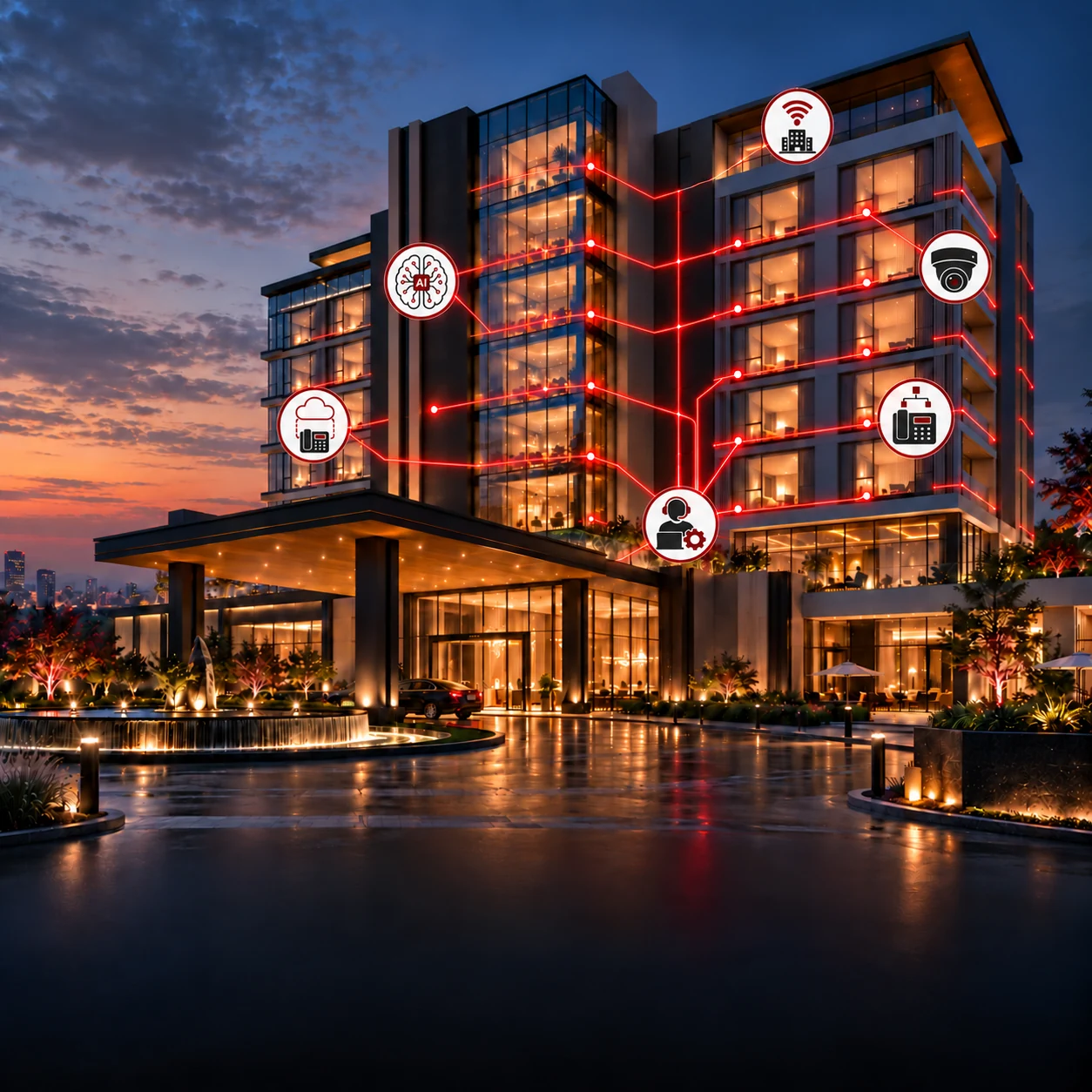
Hotel illustration is conceptual artwork, not a customer project.
Planning a hotel means making decisions today that your operations team will live with for years. I help you work through the options, define the scope, and coordinate the technology around your property, brand requirements, and opening schedule.
Review the hotel concept, room count, brand requirements, budget, and timeline. Identify what each system needs before plans become expensive to change.
Work through the network, telephone, conversational AI, guest internet, camera, and back-office IT requirements with your project team. Redwood can help arrange cabling resources when needed; low-voltage cabling is not a direct Redwood service.
Coordinate deployment, system interfaces, and service activation with Redwood. Establish support responsibilities so your team knows who to call after opening.
One point of accountability.
Your hotel shouldn't have to coordinate multiple technology companies to make connected systems work together. Redwood brings PBX, Managed SIP, guest Wi-Fi, conversational AI, CCTV, and back-office IT into one coordinated plan, with one point of accountability for the systems and services we provide.
Each is an application on the network, with its own bandwidth, power, security, segmentation, and integration needs. We consider those requirements together to simplify deployment, support, and ongoing management.
Connect your hotel PBX to outside telephone service with Redwood Managed SIP trunking. Plan the service alongside the telephone system. For new construction, coordinate service activation with opening. For existing hotels, review current service and the path to migration.
Cloud or premises-based: the choice should fit your operating model, property requirements, and budget. We work through hospitality features, PMS interfaces, guest room telephone compatibility, and support needs.
Selecting room phones? Review analog or SIP connectivity, message-waiting compatibility, guest service buttons, power, cabling, and applicable brand requirements before ordering.
Plan for how guests actually use the hotel. Coverage, capacity, switching, internet access, and guest support all matter. Start with the building and operating requirements, then select the appropriate solution.
Build a practical camera plan around the areas your team needs to see. Consider camera placement, network capacity, recording retention, and authorized access together.
Guest technology is only part of the picture. As your managed service provider (MSP), Redwood can support the back-office network and the IT systems your hotel staff relies on every day.
Work with us to define support for staff computers, servers, firewalls, and network equipment, with clear responsibilities, service coverage, and escalation procedures. Plan operational IT alongside guest-facing systems, with appropriate access controls and network separation.
Discuss your hotel's IT support ↗Final product selection and system integration depend on project scope, compatibility, and applicable brand requirements.
Plan conversational AI into a new hotel, or explore adding it to an existing telephone system. Give guests a natural way to ask questions, reach the right department, and request assistance while your staff focuses on personal service.
Explore AI for your hotel ↗Check-in times. Parking. Wi-Fi. Restaurant hours. Housekeeping. Redwood Conversational AI can handle routine conversations and connect callers with staff when personal attention is needed.
We assess your telephone system, call flows, and available integrations to define what the AI should answer, route, and complete.
Provide round-the-clock assistance for reservation inquiries and relevant upgrades or amenities. Booking, rate quotes, and reservation changes depend on supported reservation-system integrations.
Answer repetitive questions and route callers by natural speech: “I need Housekeeping” or “Connect me to Sales.” Reduce routine interruptions while keeping staff within reach.
Provide virtual concierge information and, where supported, capture and route towel, housekeeping, maintenance, and wake-up requests. Multilingual service and task completion are scoped to the selected platform and integrations.
Existing-system compatibility, brand requirements, supported languages, and PMS or reservation integrations are confirmed for each property before deployment.
Technology should enhance the guest experience and streamline operations. It should never become a barrier to either.
Guests don't see the vendor behind your network. They notice when the Wi-Fi drops, a call won't connect, or your staff can't access the systems they need.
That's when your choice of partner matters most. Look for a team that understands hotel operations, takes ownership of the issue, communicates clearly, and follows through.
Through Redwood Systems, I help you plan both the technology and the support behind it: clear service responsibilities, a defined path for escalation, and a relationship that continues after opening day.
Your hotel needs technology that works, and a partner you can reach when it doesn't.
Let's discuss your support needs ↗
Director of Business Development · Redwood Systems
I've spent approximately 40 years in technology, including more than 20 years in hospitality. My technician background shapes how I sell: understand the property, ask practical questions, and recommend a solution the hotel can operate and support.
I work through Redwood Systems to help owners, developers, and management teams plan communications, conversational AI, connectivity, security, and managed IT services for branded and independent hotels nationwide.
Questions I work through with project teams, from early planning to an operating hotel upgrade.
Start during planning or preconstruction, before cabling layouts and equipment locations are finalized. Share the floor plans, room count, brand, target opening, and expected services. Early coordination helps identify network, telephone, guest Wi-Fi, camera, and back-office requirements while the project team can still accommodate them.
The hotel name and location, brand or independent status, room count, project stage, floor plans if available, target opening, PMS, and the services you need. For an operating hotel, a current telephone bill and equipment list help with a SIP or PBX review. Initial conversations can begin before every detail is settled.
Often, but compatibility must be assessed. We review the PBX model, software, licensing, interfaces, capacity, and connectivity. Some systems need additional equipment or configuration. The recommendation should include implementation responsibilities and a review of emergency-calling requirements, rather than assuming every existing system can connect unchanged.
Many business numbers can be transferred, subject to carrier eligibility and accurate account information. Porting should be coordinated around a confirmed cutover plan. Keep the existing service active until the transfer and testing are complete. Timing and number availability are confirmed for the property.
SIP depends on connectivity, and on-site equipment also depends on power. The design can include backup connectivity, power protection, and alternate call routing where supported. Each option has limits. We review the failure scenarios and test the selected arrangement rather than treating failover as a blanket guarantee.
Sometimes. Analog phones may remain usable with a compatible PBX and appropriate interfaces, while SIP phones need compatible network and system support. Cabling, power, message-waiting indicators, and guest service buttons should be checked. VTech, Cetis, and Bittel options are considered against the selected system and hotel requirements.
That depends on connectivity, hospitality interfaces, existing equipment, ownership preferences, and ongoing costs. Compare installation, licenses or subscriptions, support, backup arrangements, and expansion needs together. Mitel, ClearlyIP ComXchange, GrayMatter Networks, and Phonesuite are evaluated according to the property's requirements and the configuration being proposed.
It may be possible with a compatible connection and call flow. We confirm how calls reach the AI and transfer back to staff. Frequently asked questions and department routing are a starting point. Reservation transactions, PMS tasks, guest requests, and languages depend on the selected platform and supported integrations.
They can use coordinated infrastructure while remaining appropriately separated. Planning covers bandwidth, switching, power, coverage, access controls, and segmentation. Camera recording and staff operations have different needs from guest internet. The aim is a network designed around those applications, not an unrestricted network shared by everyone.
Low-voltage cabling is not a direct Redwood service, but cabling resources can be arranged and requirements coordinated with your contractor. Managed IT support for back-office and staff systems is scoped separately, including the equipment covered, service hours, responsibilities, and escalation process. Those details belong in the project and service agreements.
Have a question specific to your property? Discuss it with David ↗
Have a hotel in planning or underway? Let's discuss the property, where the project stands, and what needs to happen next.
Already operating? I also welcome conversations about SIP service, conversational AI, telephone systems, guest internet, CCTV upgrades, and managed IT support.